
Fish Oil vs Cod Liver Oil: Aren't They the Same?
Many people walk into a pharmacy asking for "fish oil", only to discover there are actually two different products on the shelf — fish oil and cod liver oil.
They may look similar, come in softgel capsules, and both contain omega-3 fatty acids. So, are they interchangeable? The short answer is not always. They both come from fish but different parts.
Although both supplements originate from fish, they are produced differently. Fish oil is extracted from the flesh of oily fish such as anchovies, sardines and mackerel. It is mainly valued for its omega-3 fatty acids, EPA (eicosapentaenoic acid) and DHA (docosahexaenoic acid). While cod liver oil is extracted from the liver of cod fish. Cod liver oil naturally provides vitamins A and some cod liver oil products are further fortified with additional EPA and DHA.
Rather than assuming one is better than the other, they simply serve different nutritional purposes.
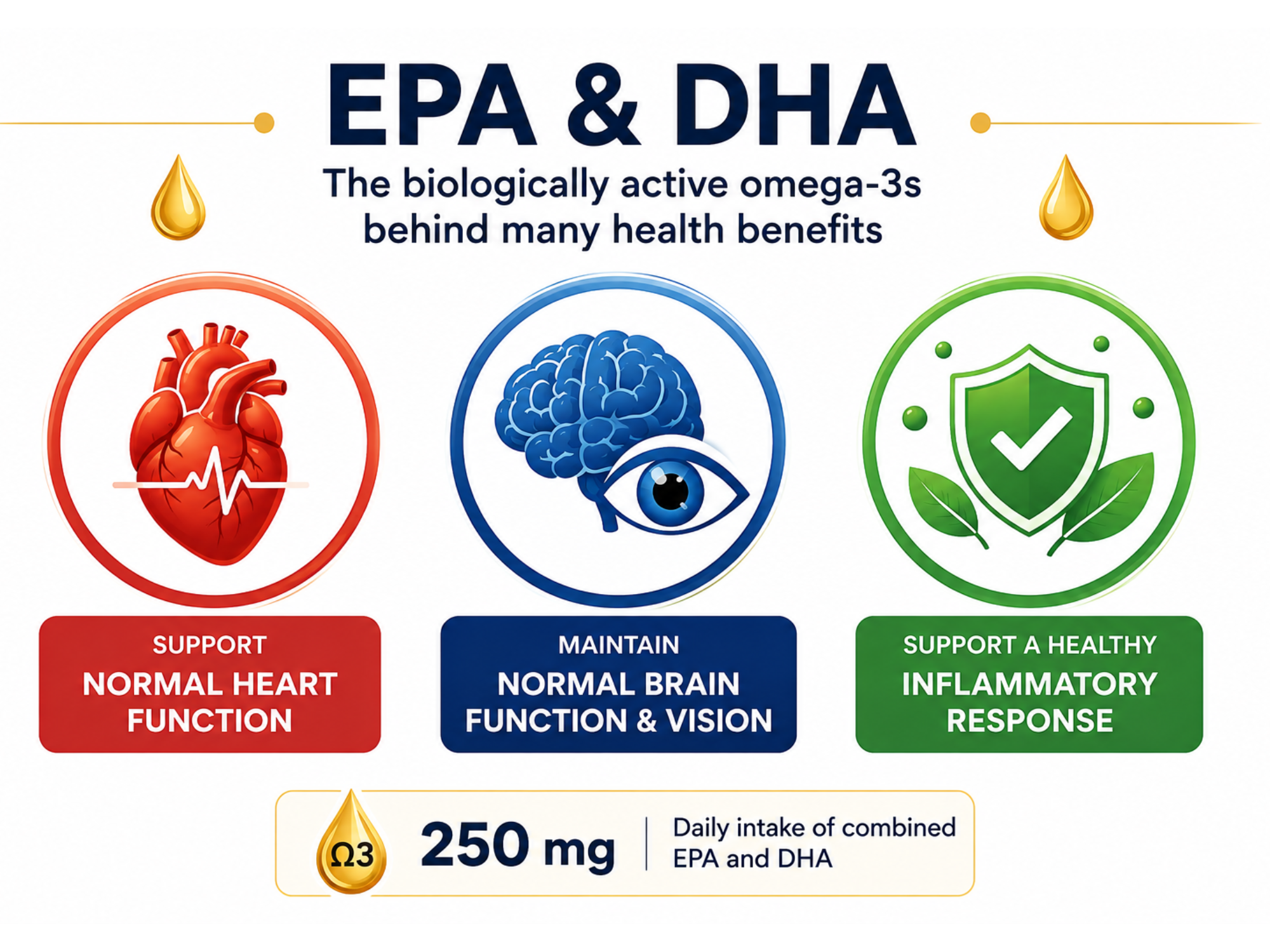
When people talk about the health benefits of omega-3, they are mainly referring to EPA and DHA.
These are the biologically active omega-3 fatty acids responsible for many of the well-recognised health benefits. Research has shown that adequate intake of EPA and DHA may help:
- Support normal heart function, with beneficial effects achieved from a daily intake of 250mg of combined EPA and DHA.1
- Maintain normal brain function and vision when consumed at 250mg daily.2
- Support a healthy inflammatory response as part of overall wellbeing.3
Although the body can produce small amounts of EPA and DHA from another omega-3 fatty acid (ALA), the conversion is limited. Regular intake through oily fish or supplements can therefore help maintain adequate levels.
Rather than asking: "Should I buy fish oil or cod liver oil?"
Ask these four questions instead:
- ✓ How much EPA & DHA does it provide?
- ✓ What is the recommended daily serving for both EPA & DHA?
- ✓ Is the fish oil sourced from high-quality, purified fish?
- ✓ Is it formulated to help maintain the quality and absorption of the omega-3?
These questions give you a much better understanding of the product than simply reading the front of the bottle.
High-quality fish oil is commonly sourced from small oily fish such as Pacific sardines and anchovies. Because these fish have shorter life cycles, they generally accumulate lower levels of environmental contaminants, including mercury, than larger predatory fish. Appeton Essentials Fish Oil with Omega-3 is sourced from Pacific sardines and anchovies harvested from the Peruvian and Chilean coasts. The fish oil is purified according to internationally recognised quality standards to help ensure product quality.
Quality also depends on how well the fish oil is protected after it is produced. Fish oil is naturally sensitive to oxygen, which may affect its stability over time. Appeton Essentials Fish Oil with Omega-3 is formulated with patented ZeecapTM Technology from France, which involves clear liquid format filled under low temperature into capsules, to preserve the integrity of fish oil’s molecular components. ZeecapTM helps ensuring the capsules sealing is airtight and help preserve product quality. Moreover, this technology ensures the capsule surface is non-permeable to odor, which will eliminate any unpleasant smell or taste. It is also easy to swallow and demonstrated 30% greater absorption than conventional formulations.
The bottom line - fish oil and cod liver oil are not the same, but neither is universally better. The right choice depends on your nutritional needs. If your goal is to increase your intake of EPA and DHA, don't just read the front of the bottle. Look at the EPA and DHA content, fish source, purification process and formulation technology. These are the factors that determine the quality of an omega-3 supplement.
Appeton Essentials Fish Oil with Omega-3 combines high-quality fish sourced from Pacific sardines and anchovies, purified fish oil, and patented ZeecapTM Technology in one convenient daily supplement, helping you make an informed choice for your omega-3 intake.

References
- European Food Safety Authority (EFSA). Scientific Opinion on Dietary Reference Values for fats. EFSA Journal, 8(3), Article 1461.
- European Food Safety Authority (EFSA). Scientific Opinion on the substantiation of health claims related to DHA and maintenance of normal brain function, normal vision and normal cardiac function pursuant to Article 13(1) of Regulation (EC) No 1924/2006. EFSA Journal, 8(10), Article 1734.
- Calder, P.C. (2017). Omega-3 fatty acids and inflammatory processes: From molecules to man. Biochemical Society Transactions, 45(5), 1105–1115.